R.O.I Analytics

Major Towns and Cities

Major Towns & Cities

Windhoek
Namibia’s capital is a busy African city with a mixed population and variety of cultures. In terms of architecture, monuments, museums and entertainment, Windhoek can’t be beaten for a Namibia travel experience. It’s also very central and not far away, in the highlands, you can experience adventurous day trips and view the wildlife, which includes aquatic birds and a variety of game such as kudu, mountain zebra and red hartebeest. Known as one of Africa’s cleanest capitals, Windhoek is also one of the most advanced in terms of infrastructure. Another interesting feature of Windhoek is its blend of German colonial architecture and modern buildings, as well as a vibrant community of artists which can be enjoyed as part of your Namibia tour.

Swakopmund
This is a small but attractive, intriguing and friendly German town, incongruously beached on the African coast. Many of the houses have towers from which their merchant owners used to watch for arriving ships, just like their counterparts. Baltic seaports and 11 buildings are now protected as national monuments. Among notable ones are the former Administrator’s summer residence, the jail - designed to look like a country house - and the imposing neo-Baroque extravagance of the railway station. They represent a heritage of German colonial architecture unparalleled elsewhere, and should be included in your Namibia travel itinerary.

National Parks

Major National Parks / Game Reserves /
Areas Of Interest

Namib-Naukluft Park
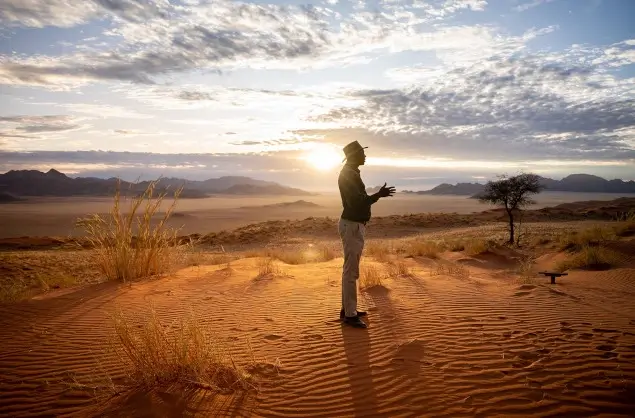
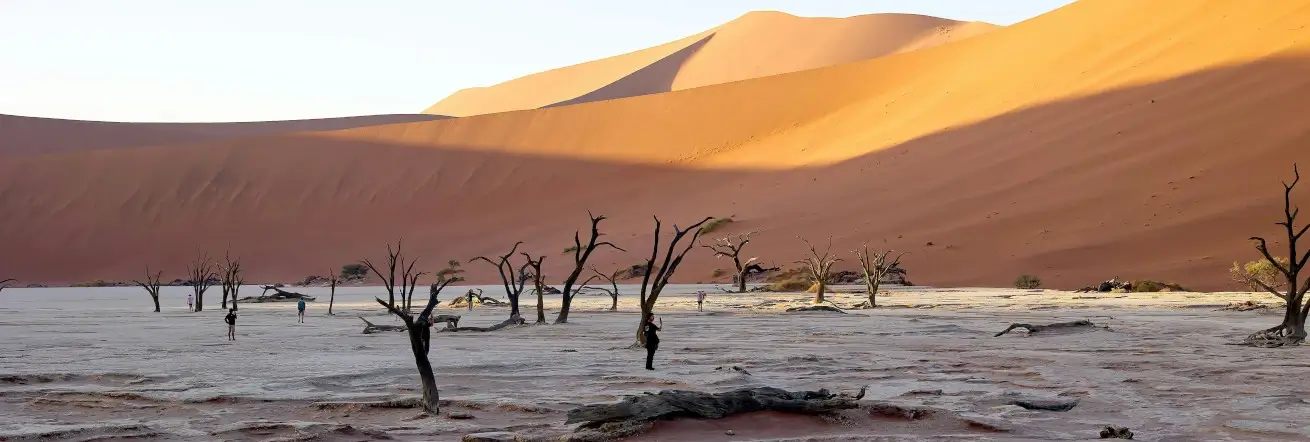
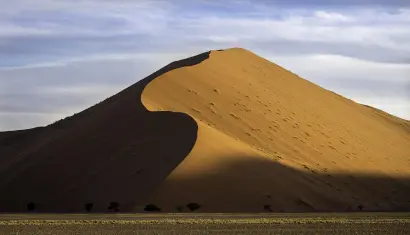
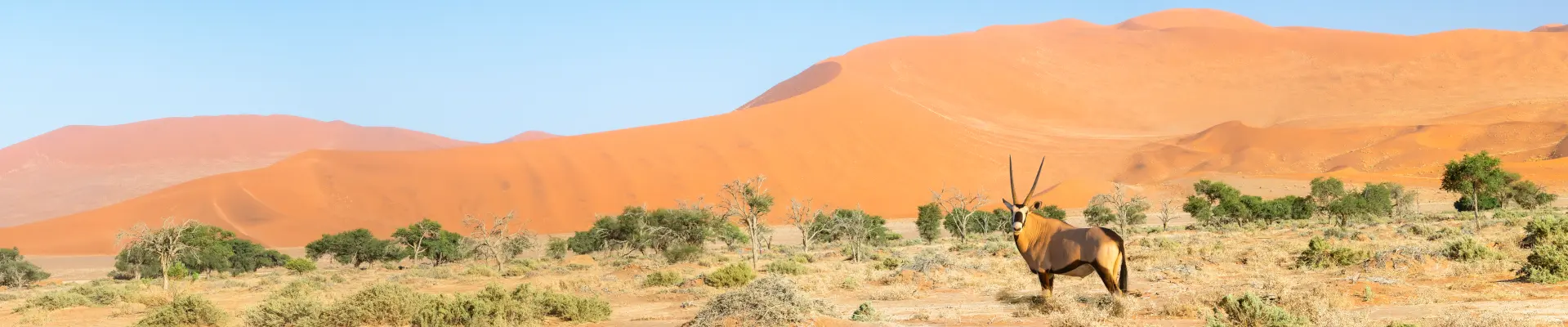
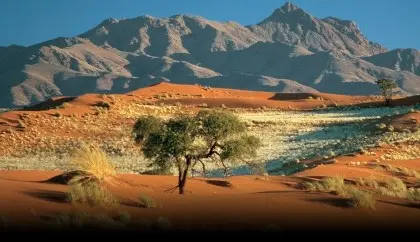
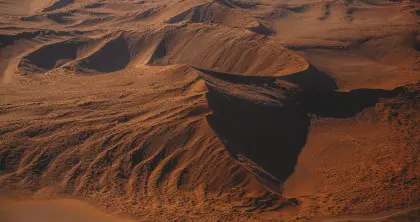
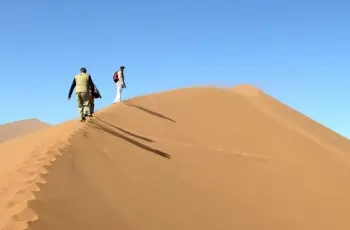
This is the largest conservation area in Namibia, incorporating most of the Namib Desert after which Namibia takes its name. This is a land of endless horizons, a place of silence and of solitude and a popular Namibia travel destination. A climb to the top of one of the gigantic sand dunes surrounding Sossusvlei to watch the sunset cast its shadow over the ancient dunes is so haunting, it will be etched in your mind forever. Near Sossusvlei, the Sesriem Canyon has been gouged out of rock over the centuries by the Tsauchab River and is now mostly small pools of water on a gravel bed, attracting many birds and animals. To the south of the park, near Luderitz, one can explore the deserted houses in the ghost town of Kolmanskop and to the west at Swakopmund, one can marvel at the fantastic rock formations of the ‘Moon Landscape’ and visit Sandwich Harbour. Also a great four-wheel drive territory, the park should only be explored with properly organised Namibia tour groups. One of Namibia’s striking contrasts, the Naukluft mountain range, differs vastly from the lower desert area where the renowned quiver trees live well in tough surroundings and mountain trees dot the landscape. This area is good for hiking. Abundant birdlife includes pelicans and flocks of up to 40 000 flamingos, a beautiful accompaniment to any Namibia travel experience.

Skeleton Coast National Park
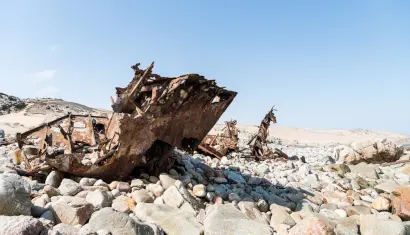
The southern section of the Skeleton Coast Park, which is accessible to the general public and Namibia safari participants, lies between the Ugab and Hoanib rivers and lures anglers from far and wide to its superb fishing grounds. This is, however, closely monitored by the Ministry of Environment and Tourism. As the shoreline moved over the years, vessels which floundered on offshore reefs and sand now lie fully exposed on the wide beaches. More interestingly, this area is a pristine coastal environment of undisturbed and unpolluted tidal zone and, in the north, at the mouth of the Kunene River, sea turtles beach to lay their eggs.

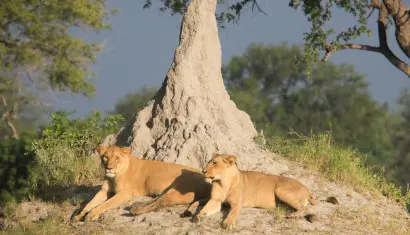
The northern Skeleton Coast is one of the planet’s most isolated places and yet a popular Namibia travel destination. It is wild, desolate, uninhabited and beautiful. This area has everything, from soaring sand dunes that roar; vast, pastel-coloured plains; towering canyons and mountains; salt-pans; seal colonies and shipwrecks. Freshwater springs permeate the barren sands to create rare oases in the desert that sustain pockets of wildlife - Springbok, Gemsbok, rare desert Elephant, Cape Fur Seals, Brown Hyena, Jackal, Ostrich, Porcupine, Giraffe, Hartmans Mountain Zebra, Black Faced Springbok and occasionally even Lion and Cheetah.

Access is restricted to the protected northern area of this park, where the coastline is dotted with forgotten shipwrecks. The Benguela Current brings cool, plankton and fish-rich waters all the way from Antarctica and moderates the temperatures in the region. The cool ocean air meets the warm desert air and nearly every morning mists cover the coastline, bringing life-sustaining moisture to the desert’s fauna and flora. Travel to Namibia and explore this wondrous ecosystem.

Etosha National Park
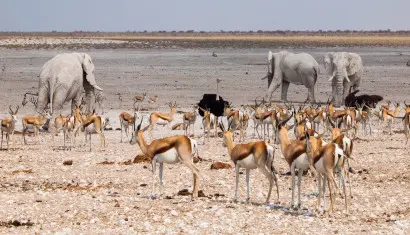
This is one of the greatest and most special Namibia safari destinations because of the great variety of game and unique vegetation to be found here. It covers 22, 270 square kilometre of country, ranging from dense bush to open plains. Its heart is the vast Etosha Pan, a shimmering grey white expanse of salt and dusty clay that is roughly 130km long. Thousands of years ago the pan was a lake fed by the Kunene River. But the river changed course and the lake shrank and dried up, the wind and heat eroding its surface so that it became slightly lower than the surrounding bush.

The name means “the place of dry water” which is an apt description of the mirages, which hover over its blinding surface. The Etosha Pan is parched and shimmering silver-white for most of the year, only filling with water about a metre deep in very rainy periods - whereupon enormous numbers of waterfowl flock to breed - a sight that is the inspiration for many a Namibia holiday. Game in Etosha includes several rare and endangered species such as black rhino and black-faced impala. After the first rains around January a large percentage of the zebra, wildebeest, gemsbok and springbok leave the southern border of the Pan and trek west, right into Owamboland. The apparent reason is that the grass is literally greener on the other side, being of an annual and not a perennial kind.

The best time for game viewing Namibia safaris is from May to October. There are many species all year round at the eastern end, attracted by the waterholes near Namutoni. Here, after the rains (January - March), the veld is green and flamingos and pelicans fly in to breed on the pans, adding to the 300 species of birds and making the spectrum of wildlife close to unique. The western half of the park has fewer roads than the area near the Pan. It includes the Fairytale Wood or Haunted Forest, a dense stand of a curious tree unique to Namibia called Moringa Ovalifolia, which resembles a thinner baobab. These trees are really only worth including in your Namibia travel itinerary after the rains. The area also protects several thousand pelicans at breeding time.

Fish River Canyon
Namibia is home to the second largest canyon in the world after the Grand
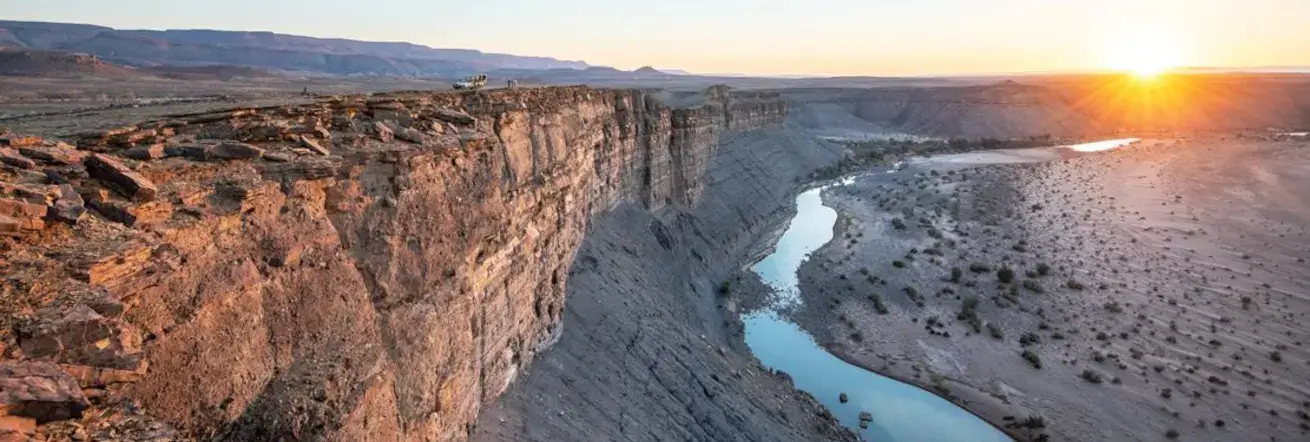
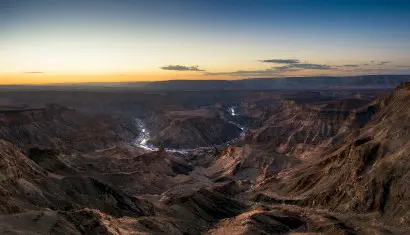
Canyon, the Fish River Canyon. A protected wildlife area, well stocked with game, it is more interesting for its geology. For the fit Namibia travel participant, an 86km hike provides insight into its sheer magnificence; otherwise there are shorter trails to lookout points on the canyon’s rim. There are hot mineral springs in the floor of the Canyon at the Ais-Ais rest camp.

The attraction of this rugged mountain land is its isolated and other worldly landscape and wealth of interesting xerophytic plants, such as the halfmens or elephant’s trunk. Set in a harsh, stony plain, dotted with drought-resistant succulents such as the distinctive quiver tree or kokerboom, the canyon is a spectacular natural phenomenon that took hundreds of millions of years to evolve into its current shape. Because the river flows intermittently, there is always water in certain of the pools, except in very dry years. The pools contain small and largemouth yellow fish, sharptooth catfish, Mozambique tilapia and common carp, and are also frequented by the water monitor or leguan.

Baboon, rock dassie, ground squirrel and klipspringer are often seen in the canyon, while the presence of leopard and the densely vegetated lower reaches, north of Ais-Ais, indicate mountain zebra. An interesting variety of birds, such as the Olive Thrush, Cape Robin and African Black duck are found in the canyon and are a popular Namibia safari attraction.

Damaraland
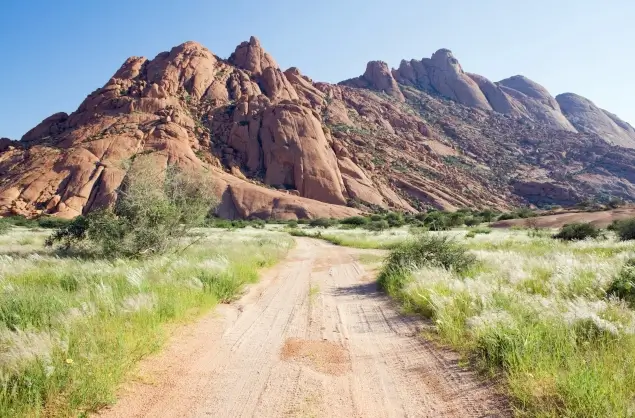
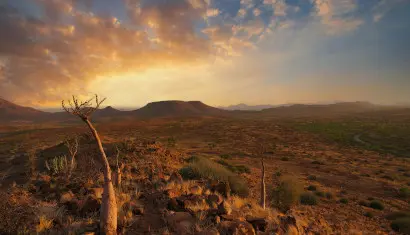
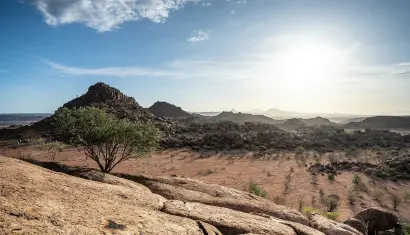
The northern areas of Damaraland feature some of Namibia’s least explored and rugged, remote areas. Here, in one of the few remaining untouched wilderness areas of Africa, it is easy to see why the San people call Namibia ‘the land that God made in anger’. The emphasis of Namibia safaris in this region is on the spectacular scenery, dominated by massive flat-topped mountains and crystal blue skies; the uniquely adapted smaller desert creatures and plants; the peace and tranquillity of being in such a remote area; and if you are extremely lucky, catching sight of the desert-dwelling elephant and black rhino that roam the area.

Southern Damaraland offers Namibia holiday makers such unique curiosities as the mystery of the Petrified Forest; the incredible collection of bushman rock engravings at Twyfelfontein, where thousands of Bushman paintings dating back over 5 000 years; the massive Vingerklip, Rock Finger; the Burnt Mountain of volcanic rock - a hill of maroon and black shale with occasional brilliant splashes of colour formed about 150 million years ago; and the nearby formation called the Organ Pipes - slim slabs of volcanic basalt, which were formed in a vertical position.

Caprivi Strip
The Caprivi Strip is an exciting destination for the adventurous Namibia traveller. It stretches like an arm across the north-eastern Namibia, opening up into a hand-shaped, fertile wilderness of riverine forests, swamps and woodland in Eastern Caprivi. The Caprivi Strip is a total contrast to the arid grandeur of the rest of Namibia. With its abundant birdlife, the area is gaining a reputation as a retreat for birdwatchers and it is also known for spectacular Namibia safari game viewing either in open 4x4 vehicles, by river craft or on foot. Among the better known reserves in the Caprivi are the Mahango Game Reserve, the Mudumu National park and the Mamili National Park.

Kaokoland
This is the traditional home of the Himba. Relying on the bare essentials due to the extreme environment in which they live, they still preserve a rich cultural tradition and a distinctive way of dress, arranging their hair in intricate plaits and covering their skin in ochre and scented herbs. The major river in this area is the Kunene, which forms the border with Angola. Visitors are advised to make use of the professionally guided tours in this part of the country and to exercise caution regarding the crocodile population and the presence of malaria in the vicinity of the river.

Ruacana Falls, one of the highest waterfalls found anywhere in Africa, is also found along the Kunene River. South of here are spectacular rock formations, including the Museum Crater, the best place to view the welwitschia mirabilis, a type of tree which has adapted to the arid conditions by becoming flat and spreading its tough foliage along the ground.

Kalkveld
Here you can see one of the few examples of dinosaur footprints found in the world. These tracks were left by a two-legged dinosaur probably about 150 million years ago and carry on for a distance of some 25 metres.

Geography

Geography

Situated along the Atlantic seaboard in the South-west of the African subcontinent, Namibia shares borders with Angola and Zambia in the north, Botswana is the east, Zimbabwe at the eastern extremity of the curiously shaped pan handle known as Caprivi, and South Africa in the South and south-east. The country comprises a long coastline which borders the Namib Desert. An escarpment leads on to the central highland regions and mountain ranges, which make it a popular Namibia tour and safari destination. The rest of the land is semi-arid desert, which is crossed by some major rivers. The extreme northern areas are tropical, especially near to the Kunene River and in parts of the Caprivi Strip, with the typical vegetation and climate of such regions. Namibia is the largest and least populated country in southern Africa. There is an estimate of 1,4 million people living there, which brings the population density to approximately 1,7 people per kilometre.

Economy

Economy

The pillars of Namibia’s economy are mining, agriculture and fishing. Tourism is currently the fastest expanding industry with more and more visitors enjoying Namibia tours each year, while the manufacturing sector is being developed. Mining makes up 49,2 % of foreign earnings and accounts for about one third of its GDP, with diamonds as the major export mineral. Others are copper, gold, zinc, lead and silver.

Visa Requirements

Visa Requirements

Whilst African Travel Gateway does not arrange visas, the following information has been provided to assist you in finding out the visa requirements for the passport that you are holding. While every effort is made to keep this information updated, it is subject to change.

Nationals from the from the following countries entering Namibia as bone fide tourists
are exempted from visa requirements: Angola, Australia, Austria, Belgium, Botswana, Brazil, Canada, Cuba, Finland, France, Germany, Italy, Japan, Kenya, Lesotho, Liechtenstein, Luxembourg, Malawi, Malaysia, Mozambique, Netherlands, New Zealand, Norway, Republic of Ireland, Russia, Spain, (South Africa *), Swaziland, Switzerland, The Scandinavian countries, Tanzania, UK, USA, Zambia, Zimbabwe.

* Non South African passport holders living in South Africa must travel with a valid passport displaying a permanent resident stamp.

Below are the issuing authorities in the Southern Africa region. One should first however, check if there is a Namibian Consulate in your country of residence. This will make the process of applying for a visa a lot simpler:


a) Namibia Tourism Cape Town
Ground floor, Main Tower, Standard Bank Centre
Heerengracht
P.O Box 739, Cape Town, 8000
Tel: (+27 21) 419 3190 begin_of_the_skype_highlighting              (+27 21) 419 3190      end_of_the_skype_highlighting / 1
Fax: (+27 21) 421 5840
E-mail: .(JavaScript must be enabled to view this email address)

b) Namibia Tourism Johannesburg
Grosvenor Corener, 195 Jan Smuts Avenue
Cnr. 7th Avenue, Rosebank
P.O Box 78946, Sandton City, 2196
Tel: (+27 11) 327 1006 / 9 / 19
Fax: (+27 11) 327 1020

c) Namibian High Commission Pretoria
P.O Box 29806, Sunnyside, 0132
702 Church Street, Pretoria
Tel: (+27 12) 481 9100
Fax: (+27 12) 343 7294 or (+27 12) 344 5998
Office hours: 08h00 - 13h00 and 14h00 - 17h00

d) Consular Office Pretoria
197 Blackwood Street, Arcadia, 0083
Tel: (+27 12) 481 9118
Fax: (+27 12) 343 7294
Office hours: 09h00 - 13h00


These offices will be closed on all South African public holidays. The Cape Town and Johannesburg tourism offices are only authorized to issue TOURIST visas.

Health Requirements

Health Requirements

Medical facilities in the major cities are of an international standard, although the remote areas are less well provided. There are relatively limited risks of malaria and bilharizia in the northern game areas, which means that the visitors should exercise common sense precautions regarding untreated water and possible exposure to mosquitoes. If you are visiting the area north of Windhoek, you must obtain malaria prophylactics before entering Namibia. It is best to consult your pharmacist or doctor in this regard before you leave for your Namibia holiday. Try to wear long sleeve clothing and trousers when outside at night. Apply plenty of insect repellent.

Medical Services

Medical Services

Namibia does not have a national health welfare scheme. Therefore it is advisable to obtain medical insurance prior to arrival. It is also wise to bring with you any medicines which you may require, since you will not have access to pharmacies in some of the areas which you will be visiting.

Best Time To Go

Best Time To Go

Namibia is an all year round destination but special interest groups should take note of the following: the best birding safaris in Africa are during the summer months because of the greater variety of species to be found. Best botanical months are December to May when the vegetation turns green, and also when most plants are in flower. Peak seasons are July to October and middle season May to June. It is advisable to book your Namibia holiday accommodation well in advance as availability will be at a premium.

Banks

Banks

WINDHOEK, SWAKOPMUND, RUNDU
Mon - Fri: 09h00 - 15h30
Sat: 08h30 - 11h00

KEETMANSHOOP, TSUMEB
Mon - Fri: 09h30 - 12h30 and 14h00 - 15h30
Sat: 08h30 - 10h30

KATIMA MULILO
Mon - Fri: 09h00 - 12h45 and 14h00 - 14h30

Currency

Currency

The currency is the Namibian dollar (N$), divided into 100 cents. It is directly linked in value to the South African Rand. Any amount of foreign currency may be bought into the country, but the limit for import and export if N$ is 500.

Languages

Languages

Although English is the official language, both Afrikaans and German are frequently used. The major African tongues are Herero and Ovambo, with up to nine other languages in some areas.

Culture & Religion

Culture & Religion

The many people who make up the Namibian population each maintain their own distinctive cultural traditions, which vary from German and Afrikaans for the colonial settlers to the many different tribal practices of the indigenous inhabitants. These represent all the major types of culture from hunter-gatherers (San) to nomadic farmers (Himba) and subsistence farmers like the Ovambo and Herero. Towns and cities have an old fashioned but European ambience resulting from the country’s long history of colonial rule and it is only in the most remote areas you will find tribal African culture. There is a general following of Christian beliefs and social customs, with some tribal beliefs maintained in rural areas.

Food & Wine

Food & Wine

Cuisine varies from area to area. You can, however, find German cuisine throughout Namibia, ranging from pastries to Bavarian beer, Bratwurst and Sauerkraut.

Shopping

Shopping

In the major centres of Windhoek and Swakopmund, many shops specialise in attractive local products such as diamonds and semi-precious stones. Curios of all types are available, including dolls dressed in the traditional Herero style (these are made by Herero woman), hand-carved wooden objects, beautifully fashioned jewellery, shoes made of Kudu leather, karosses (rugs made from the pelts of wild animals), and popular SWAKARA garments that you may take home as keepsakes of your Namibia tour.

Electricity

Electricity

Electricity is 220 and 240V AC, 50Hz. Lodges in the more remote areas may not have electricity and rely on generator power. You will not find plug sockets in your room/tent at these lodges.

Water

Water

The water supply in all Namibian towns is safe. Country areas typically rely on borehole or spring water, which is safe if boiled. Boiling, filtering and purification are recommended in places where the water is from rivers or lakes or when large numbers of livestock also use the water. Water at the hotels, inns, lodges and other public places as well as tap water is safe to drink. Please remember that water is precious in this drought-stricken land so try to make an effort to conserve as much as you can.

There is a Namibia safari package to suit every taste and budget. You can travel in economy or in ultimate luxury, be guided or lead yourself, and explore everything from wildlife, culture and geology to archaeological sites and cuisine. Namibia holidays are very popular with foreign visitors due to the country’s bountiful sunshine, abundant wildlife, breathtaking scenery and diverse geological makeup.

Fish River Canyon Area (Southern Namibia)

Namibia is home to the second largest canyon in the world after the Grand Canyon, the Fish River Canyon. A protected wildlife area, well stocked with game, it is more interesting for its geology. For the fit Namibia travel participant, an 86km hike provides insight into its sheer magnificence; otherwise there are shorter trails to lookout points on the canyon’s rim. There are hot mineral springs in the floor of the Canyon at the Ais-Ais rest camp.

Read more

The Caprivi Area

The Caprivi Strip is an exciting destination for the adventurous Namibia traveller. It stretches like an arm across the north-eastern Namibia, opening up into a hand-shaped, fertile wilderness of riverine forests, swamps and woodland in Eastern Caprivi. The Caprivi Strip is a total contrast to the arid grandeur of the rest of Namibia. With its abundant birdlife, the area is gaining a reputation as a retreat for birdwatchers and it is also known for spectacular Namibia safari game viewing either in open 4x4 vehicles, by river craft or on foot. Among the better known reserves in the Caprivi are the Mahango Game Reserve, the Mudumu National park and the Mamili National Park.

Read more

The Central & Waterberg Area

Rising some 200m above a surrounding sea of African bush and savannah, the Waterberg Plateau with its flamboyant brick-red sandstone formations and lush green vegetation, presents an island of vibrant colour. The 405.5Km² park, situated 60Km east of Otjiwarongo and 300 Km north east of Windhoek was proclaimed in 1972. It was originally created as a sanctuary for rare and endangered species found in the Kavango and Caprivi regions, such as roan and sable antelope, tsessebe and Cape buffalo. Today the park is home to some 25 game and over 200 bird species. The vegetation changes dramatically from acacia savannah at the foot of the plateau to lush-green sub-tropical dry woodlands with tall trees and grassy plains at the top.

Read more

The Damaraland Area

The Damaraland features some of Namibia’s least explored and rugged, remote areas. Here, in one of the few remaining untouched wilderness areas of Africa, it is easy to see why the San people call Namibia ‘the land that God made in anger’. The emphasis of Namibia safaris in this region is on the spectacular scenery, dominated by massive flat-topped mountains and crystal blue skies; the uniquely adapted smaller desert creatures and plants; the peace and tranquillity of being in such a remote area; and if you are extremely lucky, catching sight of the desert-dwelling elephant and black rhino that roam the area.

Read more

The Etosha Area

This is one of the greatest and most special Namibia safari destinations because of the great variety of game and unique vegetation to be found here. It covers 22, 270 square kilometre of country, ranging from dense bush to open plains. Its heart is the vast Etosha Pan, a shimmering grey white expanse of salt and dusty clay that is roughly 130km long. Thousands of years ago the pan was a lake fed by the Kunene River. But the river changed course and the lake shrank and dried up, the wind and heat eroding its surface so that it became slightly lower than the surrounding bush.

Read more

The Owamboland Area (Northern Namibia)

A large percentage of Namibia ‘s inhabitants live in the Owambo regions of Omusati, Oshana, Ohangwena and Oshikoto. The major portion of the four regions consists of communal land where the majority of the inhabitants live from subsistence faming. Life on the vast plains of these essentially agricultural regions depends on the seasonal efundja, the floods that feed the rivers and oshonas. The flat landscape is typified by big spreading Marula trees and sporadic stands of the tall makalani palm. Sap is tapped from the growing tip of the stems of these palms and let to ferment into a potent drink called palm wine. The fruit of the makalani palm takes two years to mature and has a white, bony kernel. Referred to as vegetable ivory, the hard kernel is suitable for carving into small ornaments, jewellery and curios.

Read more

The Skeleton Coast Area

The southern section of the Skeleton Coast Park, which is accessible to the general public and Namibia safari participants, lies between the Ugab and Hoanib rivers and lures anglers from far and wide to its superb fishing grounds. This is, however, closely monitored by the Ministry of Environment and Tourism. As the shoreline moved over the years, vessels which floundered on offshore reefs and sand now lie fully exposed on the wide beaches. More interestingly, this area is a pristine coastal environment of undisturbed and unpolluted tidal zone and, in the north, at the mouth of the Kunene River, sea turtles beach to lay their eggs.

Read more

The Sossusvlei Area

This is the largest conservation area in Namibia, incorporating most of the Namib Desert after which Namibia takes its name. This is a land of endless horizons, a place of silence and of solitude and a popular Namibia travel destination. A climb to the top of one of the gigantic sand dunes surrounding Sossusvlei to watch the sunset cast its shadow over the ancient dunes is so haunting, it will be etched in your mind forever. Near Sossusvlei, the Sesriem Canyon has been gouged out of rock over the centuries by the Tsauchab River and is now mostly small pools of water on a gravel bed, attracting many birds and animals.

Read more

The Swakopmund Area

This is a small but attractive, intriguing and friendly German town, incongruously beached on the African coast. Many of the houses have towers from which their merchant owners used to watch for arriving ships, just like their counterparts. Baltic seaports and 11 buildings are now protected as national monuments. Among notable ones are the former Administrator’s summer residence, the jail - designed to look like a country house - and the imposing neo-Baroque extravagance of the railway station.

Read more

The Windhoek Area

Namibia’s capital is a busy African city with a mixed population and variety of cultures. In terms of architecture, monuments, museums and entertainment, Windhoek can’t be beaten for a Namibia travel experience. It’s also very central and not far away, in the highlands, you can experience adventurous day trips and view the wildlife, which includes aquatic birds and a variety of game such as kudu, mountain zebra and red hartebeest. Known as one of Africa’s cleanest capitals, Windhoek is also one of the most advanced in terms of infrastructure.

Read more

4 Day Namibia Skeleton Coast - Safari A

The Safari A, is a 4 day Fly In Safari over some of the best and most remote areas of Namibia. Read more

4 Day Namibia Skeleton Coast - Safari B

The Safari B, is a 4 day Fly In Safari over some of the best and most remote areas of Namibia, including Sossuvlei Read more

5 Day Namibia Skeleton Coast - Safari C

The 5 Day Safari C, flies into some of the most beautiful areas of Namibia, including Etosha, Kunene Hoarusib Valley Read more

6 Day Namibia Skeleton Coast - Safari D

The 6 Day Safari D, covers remote & spectacular areas of Namibia's wilderness. Sea, shipwrecks, deserts, mountains & rivers. Read more

Best Of Namibia Safari

This 7 Day Safari offers daily departures, the safari reflects the stark contrasts of Namibia and uses various camps Read more

Spirit Of The Namib Safari

This great all round 10 day safari reveals the vast and varied desert, the living Atlantic Coast and spectacular vistas. Read more