Hotels & Lodges - Namibia
Namibia is a fascinating Southern African country and offers visitors a diverse range of experiences ranging from wildlife, culture, amazing desert scenery, archeological phenomena to some of the wildest and remote wilderness areas left on the continent.
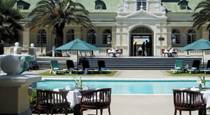
Accommodation in Namibia takes more than just the form of hotels and lodges. Game lodges, tented safari camps, wildlife resorts, guest farms and guest houses, all play a major role in tourist accommodation in Namibia.
We have divided Namibia up into 10 regions of interest, from a tourists point of view. Under each area we have listed hotels and lodges and other accommodation options that can be found. These lists are updated regularly.
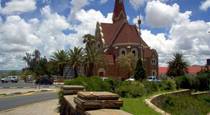
The Windhoek Area
Namibia’s capital is a busy African city with a mixed population and variety of cultures. In terms of architecture, monuments, museums and entertainment, Windhoek can’t be beaten for a Namibia travel experience. It’s also very central and not far away, in the highlands, you can experience adventurous day trips and view the wildlife, which includes aquatic birds and a variety of game such as kudu, mountain zebra and red hartebeest. Known as one of Africa’s cleanest capitals, Windhoek is also one of the most advanced in terms of infrastructure.
Read more
The Central & Waterberg Area
Rising some 200m above a surrounding sea of African bush and savannah, the Waterberg Plateau with its flamboyant brick-red sandstone formations and lush green vegetation, presents an island of vibrant colour. The 405.5Km ² park, situated 60Km east of Otjiwarongo and 300 Km north east of Windhoek was proclaimed in 1972. It was originally created as a sanctuary for rare and endangered species found in the Kavango and Caprivi regions, such as roan and sable antelope, tsessebe and Cape buffalo. Today the park is home to some 25 game and over 200 bird species. The vegetation changes dramatically from acacia savannah at the foot of the plateau to lush-green sub-tropical dry woodlands with tall trees and grassy plains at the top.
Read more
The Swakopmund Area
This is a small but attractive, intriguing and friendly German town, incongruously beached on the African coast. Many of the houses have towers from which their merchant owners used to watch for arriving ships, just like their counterparts. Baltic seaports and 11 buildings are now protected as national monuments. Among notable ones are the former Administrator’s summer residence, the jail - designed to look like a country house - and the imposing neo-Baroque extravagance of the railway station.
Read more
Fish River Canyon Area (Southern Namibia)
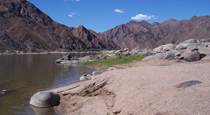
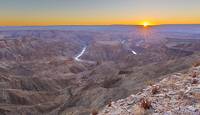
Namibia is home to the second largest canyon in the world after the Grand Canyon, the Fish River Canyon. A protected wildlife area, well stocked with game, it is more interesting for its geology. For the fit Namibia travel participant, an 86km hike provides insight into its sheer magnificence; otherwise there are shorter trails to lookout points on the canyon’s rim. There are hot mineral springs in the floor of the Canyon at the Ais-Ais rest camp.
Read more
The Sossusvlei Area
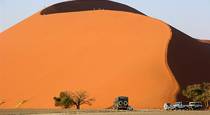
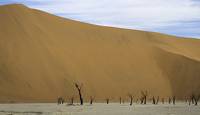
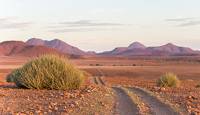
This is the largest conservation area in Namibia, incorporating most of the Namib Desert after which Namibia takes its name. This is a land of endless horizons, a place of silence and of solitude and a popular Namibia travel destination. A climb to the top of one of the gigantic sand dunes surrounding Sossusvlei to watch the sunset cast its shadow over the ancient dunes is so haunting, it will be etched in your mind forever. Near Sossusvlei, the Sesriem Canyon has been gouged out of rock over the centuries by the Tsauchab River and is now mostly small pools of water on a gravel bed, attracting many birds and animals.
Read more
The Skeleton Coast Area
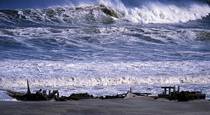
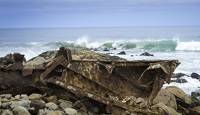
The southern section of the Skeleton Coast Park, which is accessible to the general public and Namibia safari participants, lies between the Ugab and Hoanib rivers and lures anglers from far and wide to its superb fishing grounds. This is, however, closely monitored by the Ministry of Environment and Tourism. As the shoreline moved over the years, vessels which floundered on offshore reefs and sand now lie fully exposed on the wide beaches. More interestingly, this area is a pristine coastal environment of undisturbed and unpolluted tidal zone and, in the north, at the mouth of the Kunene River, sea turtles beach to lay their eggs.
Read more
The Owamboland Area (Northern Namibia)
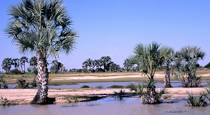
A large percentage of Namibia ‘s inhabitants live in the Owambo regions of Omusati, Oshana, Ohangwena and Oshikoto. The major portion of the four regions consists of communal land where the majority of the inhabitants live from subsistence faming. Life on the vast plains of these essentially agricultural regions depends on the seasonal efundja, the floods that feed the rivers and oshonas. The flat landscape is typified by big spreading Marula trees and sporadic stands of the tall makalani palm. Sap is tapped from the growing tip of the stems of these palms and let to ferment into a potent drink called palm wine. The fruit of the makalani palm takes two years to mature and has a white, bony kernel. Referred to as vegetable ivory, the hard kernel is suitable for carving into small ornaments, jewellery and curios.
Read more
The Caprivi Area
The Caprivi Strip is an exciting destination for the adventurous Namibia traveller. It stretches like an arm across the north-eastern Namibia, opening up into a hand-shaped, fertile wilderness of riverine forests, swamps and woodland in Eastern Caprivi. The Caprivi Strip is a total contrast to the arid grandeur of the rest of Namibia. With its abundant birdlife, the area is gaining a reputation as a retreat for birdwatchers and it is also known for spectacular Namibia safari game viewing either in open 4x4 vehicles, by river craft or on foot. Among the better known reserves in the Caprivi are the Mahango Game Reserve, the Mudumu National park and the Mamili National Park.
Read more
The Etosha Area
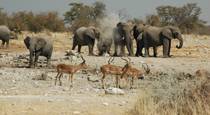
This is one of the greatest and most special Namibia safari destinations because of the great variety of game and unique vegetation to be found here. It covers 22, 270 square kilometre of country, ranging from dense bush to open plains. Its heart is the vast Etosha Pan, a shimmering grey white expanse of salt and dusty clay that is roughly 130km long. Thousands of years ago the pan was a lake fed by the Kunene River. But the river changed course and the lake shrank and dried up, the wind and heat eroding its surface so that it became slightly lower than the surrounding bush.
Read more
The Damaraland Area
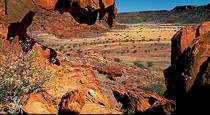
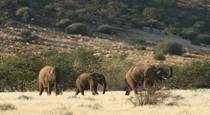
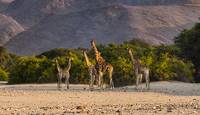
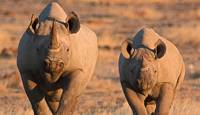
The Damaraland features some of Namibia’s least explored and rugged, remote areas. Here, in one of the few remaining untouched wilderness areas of Africa, it is easy to see why the San people call Namibia ‘the land that God made in anger’. The emphasis of Namibia safaris in this region is on the spectacular scenery, dominated by massive flat-topped mountains and crystal blue skies; the uniquely adapted smaller desert creatures and plants; the peace and tranquillity of being in such a remote area; and if you are extremely lucky, catching sight of the desert-dwelling elephant and black rhino that roam the area.
Read more
See our African Safari Specials ... here we host great specials for safaris, tours, hotels and lodges !! Take a look at the New Blue Train Special added on 17 Jan 2012 ...
Take a look at what's new in the Africa Safari industry ... here we host African safari news, new safari camps, new African tours, important travel alerts and more ... the latest addition, the Selinda Canoe Trail in Botswana!